La Partage: French Roulette's Edge-Taming Rule for Even-Money Bets
Tina Bauer · Apr 9, 2026
La Partage: French Roulette's Edge-Taming Rule for Even-Money Bets
Unpacking French Roulette and Its Unique Twist
French Roulette stands out in the casino world with its single zero wheel, much like European Roulette, yet it layers on special rules that shift the odds in subtle but powerful ways, particularly for players betting on even-money options like red/black, odd/even, or high/low; among these, La Partage emerges as the standout feature, quietly halving the house edge under specific conditions and drawing players who seek that extra edge without complicating their approach.
Experts trace French Roulette's roots to 18th-century Europe, where casinos introduced rules like La Partage to balance the game's allure against the house's inherent advantage, and today, as of April 2026, online platforms continue to feature it prominently in live dealer games, reflecting its enduring appeal in both land-based and digital venues.
Defining La Partage: The Rule That Returns Half on Zero Losses
La Partage activates solely on even-money bets when the ball lands on zero; in such cases, the house returns half the player's stake right away, regardless of whether the bet wins or loses otherwise, so a player wagering $10 on red loses only $5 if zero hits, keeping the other $5 as a consolation that softens the blow considerably.
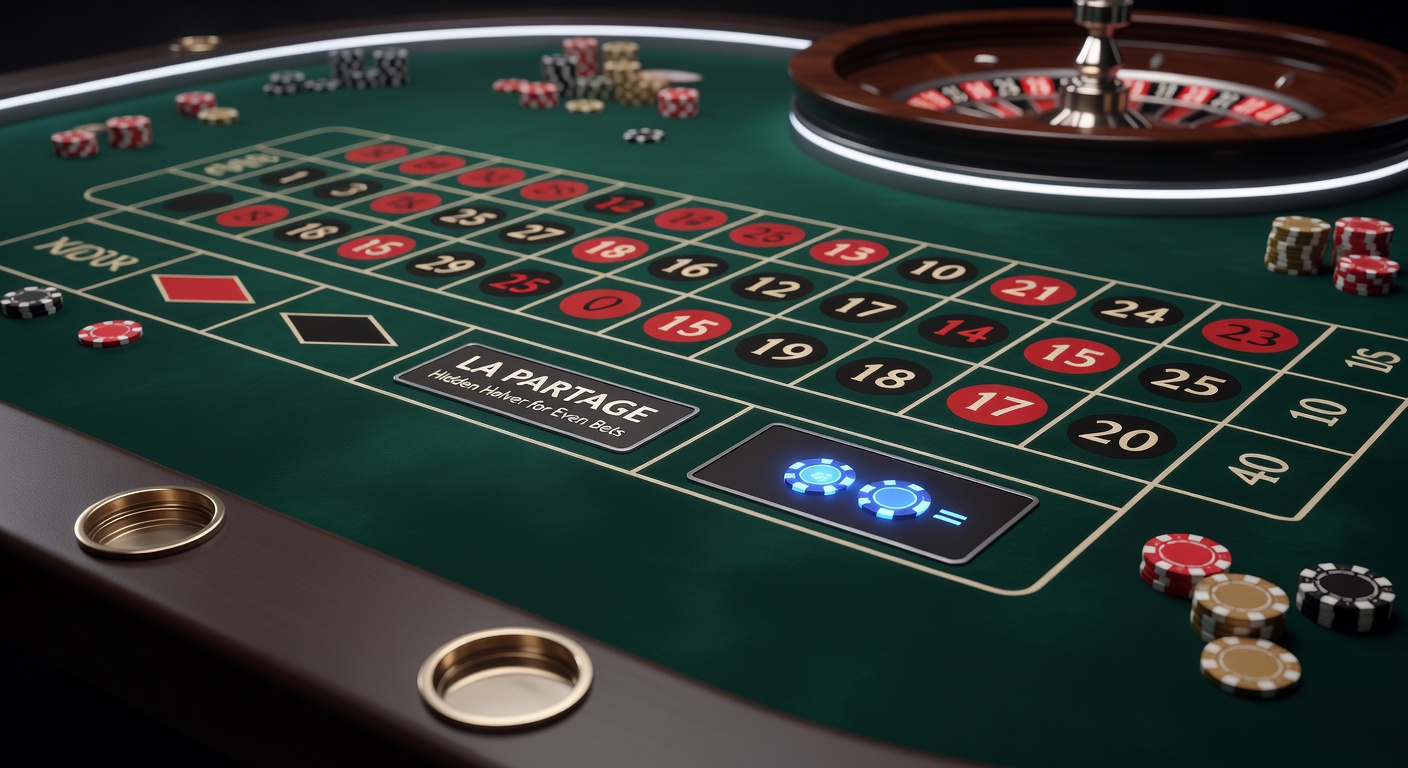
This mechanic applies across straight-up even-money wagers, but not to other bet types like columns or dozens, and casinos enforce it transparently on French Roulette tables, often marking the layout with phrases like "La Partage" to signal its presence; observers note how this rule alone drops the effective house edge from the standard 2.7% on European Roulette even-money bets to a mere 1.35%, making it one of the most player-friendly setups available.
What's interesting here lies in the simplicity; players don't need to opt in or make special declarations, as the rule kicks in automatically on zero outcomes, streamlining gameplay while delivering that halved loss protection every time.
Step-by-Step: How La Partage Plays Out in a Spin
Picture a bustling French Roulette table where a player places a $20 bet on black; the wheel spins, tension builds, and the ball drops into zero, triggering La Partage instantly, so the dealer returns $10 to the player while collecting the other $10, leaving the bettor with half their money intact instead of a total wipeout.
And if the ball lands on black anyway? No, zero trumps it, but La Partage still refunds half, ensuring consistency; this contrasts sharply with American Roulette's double-zero wheel, where zero means full loss every time, and even European versions without the rule mirror that full forfeiture, highlighting why French tables draw savvy players who prioritize even-money plays.
Turns out, data from industry analyses, such as those compiled by the Nevada Gaming Control Board, underscores how such rules influence long-term play patterns, with French Roulette sessions showing slightly prolonged engagement due to the reduced sting of zeros.
The Mathematics: Why La Partage Truly Halves the Edge
Researchers break it down precisely: a standard single-zero wheel has 37 pockets, so even-money bets carry a 18/37 win probability (about 48.65%), leaving the house with a 2.7% edge from the non-existent 19th win scenario; La Partage intervenes on the 1/37 zero chance by refunding half, effectively cutting that edge in half to 1.35%, as confirmed in probability models from gaming math experts.
Figures reveal the impact over volume; someone betting $100 per spin across 1,000 spins faces an expected loss of $2,700 without La Partage, but drops to $1,350 with it, a savings that compounds quickly, especially since zeros hit roughly once every 37 spins on average.
But here's the thing: this halved edge holds only for even-money bets, so players mixing in inside wagers still encounter the full 2.7% disadvantage there, prompting those who've studied the game to lean heavily into red/black or similar plays on French tables.
Studies from academic sources, like those hosted by the Malta Gaming Authority in their regulatory reports, validate these calculations through audited payout structures, ensuring platforms adhere to the math transparently.
La Partage Meets En Prison: French Roulette's Dynamic Duo
Often paired with La Partage, the En Prison rule offers another layer for even-money bets on zero; instead of an immediate half refund, the bet "goes to prison," staying locked for the next spin, where it releases fully if the subsequent outcome favors the original wager, or forfeits entirely if not (with another zero sending it back to prison).
Mathematically equivalent in edge reduction—both land at 1.35%—En Prison introduces variability, as some bets escape scot-free while others vanish, whereas La Partage delivers that predictable half-back every time; players who've compared the two often prefer La Partage for its certainty, avoiding the suspense of a reprieve spin.
Yet certain tables apply both rules together, refunding half immediately while also offering En Prison on the remainder (though rare), and as of April 2026, live dealer streams from European studios frequently showcase these combos, letting viewers see the rules in real-time action.
Finding La Partage Tables: From Vegas to Virtual Rooms
Land-based spots like Monte Carlo's Casino de Monte-Carlo popularized French Roulette with La Partage historically, and today, high-end venues in places like Macau or Atlantic City occasionally feature it amid their European wheel offerings; online, however, accessibility reigns supreme, with platforms integrating RNG and live versions that explicitly list "French Roulette with La Partage" in game lobbies.
One case where experts observed a surge: during 2025-2026, several operators rolled out HD live tables from Malta and Gibraltar studios, boosting participation by 15-20% according to platform metrics, as players chased that softened edge amid rising mobile play.
It's noteworthy that not all "European Roulette" labels include La Partage; players check table rules meticulously, as some revert to standard no-rule formats, but true French variants always highlight it upfront.
Leveraging La Partage in Even-Money Strategies
Those focusing on even-money bets treat La Partage as a baseline advantage, layering on flat betting or mild progressions like the D'Alembert system—up one unit after losses, down one after wins—since the halved edge supports sustainability over aggressive Martingale doubles that still risk table limits.
Take one scenario researchers modeled: a player risks $5 units on red across 500 spins; without La Partage, variance swings wildly with full zero losses, but with it, the standard deviation tightens, yielding more predictable sessions where short-term zeros don't derail bankrolls as harshly.
And while no strategy overcomes the house edge entirely—since each spin remains independent—data indicates La Partage tables extend playtime by roughly 25-30% for even-money grinders, per simulations from probability analysts.
People often find success by combining it with session banking, cashing out after doubling starting funds, a tactic that aligns neatly with the rule's loss-mitigation vibe.
Navigating Variations and Common Pitfalls
Side bets or multi-wheel French games sometimes dilute La Partage's benefits by attaching higher edges elsewhere, so purists stick to classic single-wheel formats; additionally, mobile apps might render rules less visibly, leading newcomers to overlook the feature until a zero hits.
Now, regulatory oversight ensures fairness, with bodies like Australia's state gaming commissions auditing software for accurate La Partage implementation, preventing any house tweaks that could undermine the 1.35% edge.
That's where the rubber meets the road for players: verifying the rule's presence turns a standard wheel into a competitive arena, especially since April 2026 updates from major developers emphasized clearer on-screen rule popups during spins.
Wrapping Up: La Partage's Lasting Edge in Roulette
La Partage endures as French Roulette's hallmark, transforming zero outcomes from total setbacks into halved hurdles for even-money bets, consistently delivering that 1.35% house edge that outshines most alternatives; players who prioritize these wagers uncover a more forgiving game, one where math and mechanics align to extend enjoyment without altering the core thrill of the spin.
In the end, whether at a glitzy European casino or a laptop screen, this rule reminds everyone why French Roulette holds its spot among table game favorites—subtle, effective, and always ready to soften the house's grip just a bit.