Bankroll Swings: Alternating Between Volatile Slots and Blackjack Tables
Vera Schwarz · May 30, 2026

Bankroll Swings: Alternating Between Volatile Slots and Blackjack Tables
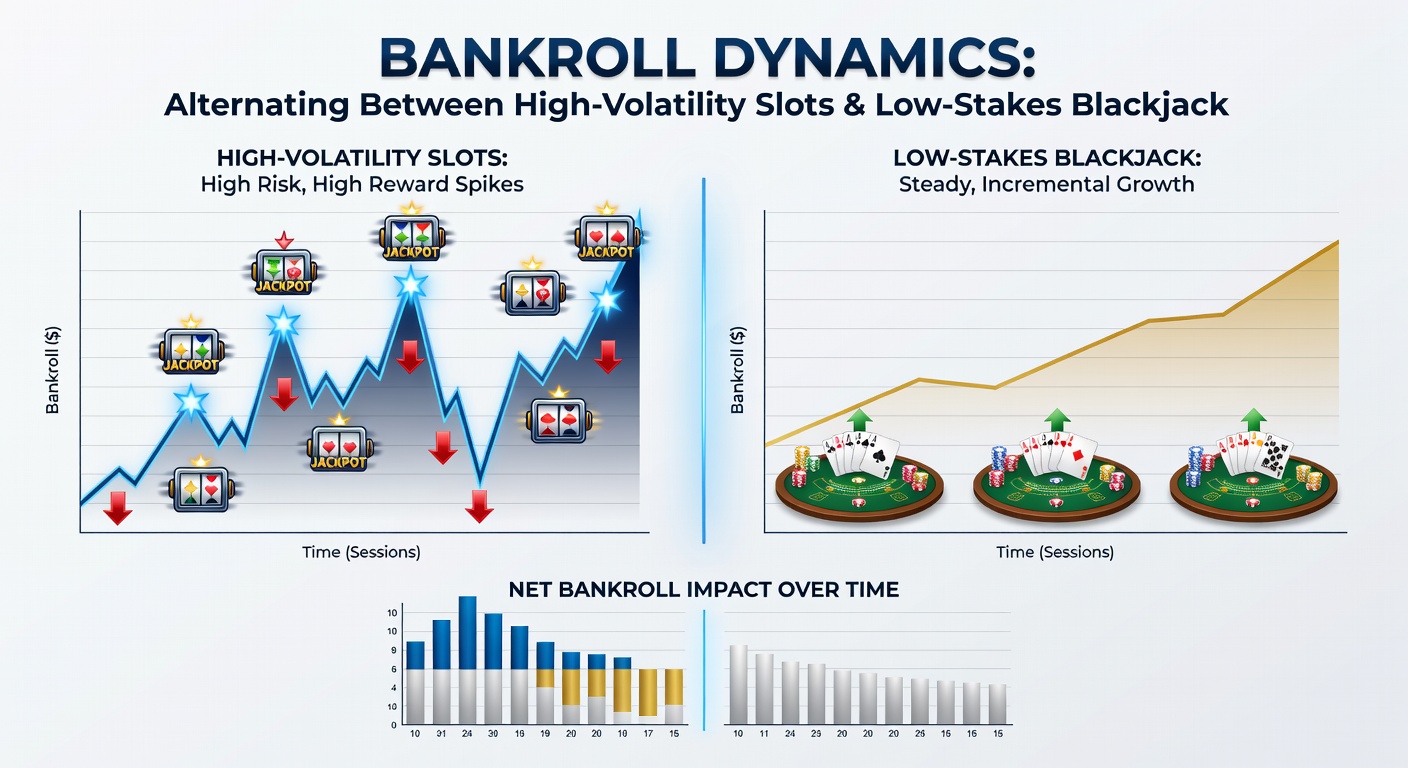
Players who switch between high-volatility slots and low-stakes blackjack experience distinct patterns in how their bankrolls rise and fall over extended sessions, and data from multiple gaming jurisdictions shows these shifts often follow predictable mathematical structures rather than random chance alone. High-volatility slots create large swings because their payout distributions concentrate wins in infrequent but substantial amounts, whereas low-stakes blackjack delivers steadier returns when basic strategy guides decisions.
Volatility Profiles in Each Game Type
High-volatility slots carry return-to-player percentages that typically range between 94 and 97 percent according to aggregated machine data compiled by the Nevada Gaming Control Board, yet the standard deviation remains elevated because most spins return nothing while occasional sequences deliver multipliers exceeding 100 times the bet. Low-stakes blackjack tables, by contrast, operate with house edges near 0.5 percent when players follow optimal charts, and the lower variance stems from frequent small outcomes that gradually erode or preserve capital.
Those who track session results across both formats notice that slot sequences often produce extended losing stretches lasting 50 to 200 spins before a recovery hit appears, while blackjack hands resolve every 30 to 60 seconds with outcomes clustered closer to the mean. This difference in frequency and magnitude forces bankroll allocation decisions that account for the longest expected downswing in each game.
Effects of Alternating Between Formats
Switching mid-session alters the overall variance profile because the steadier blackjack results can offset some of the extreme slot movements, and research from the University of Nevada Reno Gaming Laboratory indicates that combined play reduces the probability of total bankroll depletion compared with exclusive slot sessions of equivalent length. Players commonly reserve 60 to 70 percent of their session funds for slots when they intend to intersperse blackjack rounds, allowing the lower-volatility game to rebuild reserves after heavy slot losses.
Figures from the Australian Gambling Research Centre reveal that sessions mixing both formats last 20 to 30 percent longer on average before players reach self-imposed loss limits, largely because blackjack stretches provide recovery intervals that prevent premature exits during slot cold streaks. The timing of switches matters as well, since moving to blackjack immediately after a large slot payout locks in gains at a lower risk level.
Bankroll Allocation Patterns
Observers who review transaction logs from regulated platforms note that players frequently adjust unit sizes when moving between the two games, increasing blackjack bets by 10 to 15 percent after successful slot runs while reducing slot bets following blackjack losses to maintain overall exposure. This cross-format sizing prevents any single game type from dominating total risk, and it aligns with variance calculations that treat the combined session as a portfolio of assets with differing volatilities.
Low-stakes blackjack tables typically accept minimum bets from $5 to $15, which allows precise control over hourly loss rates around $20 to $40 under standard conditions, whereas high-volatility slots at similar minimums can produce hourly swings exceeding $150 during peak volatility periods. Those who maintain separate mental ledgers for each game type track these rates separately and rebalance when one ledger drops below a predetermined threshold.
Regulatory Context in 2026
May 2026 brings updated stake frameworks in several North American markets that cap maximum bets on certain slot categories while leaving blackjack limits largely unchanged, and these adjustments may encourage more frequent alternation because players seek to stay within new per-spin boundaries on slots. Data collected after similar rule changes in prior years shows increased table game traffic during peak hours as players rotate to maintain session length.
Practical Session Structures
Structured alternation often follows a 3-to-1 or 4-to-1 ratio of slot spins to blackjack hands, which balances the entertainment value of slots against the slower capital erosion of blackjack. Players who adopt fixed rotation schedules rather than emotion-driven switches report lower standard deviation in end-of-session results, according to anonymized play data shared by several North American operators.
One documented pattern involves starting with 100 slot spins at a fixed bet size, then moving to 30 blackjack hands before returning to slots, a cycle that repeats until either a profit target or loss limit is reached. This rhythm uses blackjack as a deliberate variance dampener while still allocating the majority of time to the higher-volatility option.
Conclusion
Bankroll dynamics shift measurably when players move between high-volatility slots and low-stakes blackjack, and the combination produces a moderated variance profile that extends playable time while preserving the potential for larger slot-driven wins. Allocation percentages, switch timing, and rotation ratios each influence final outcomes, and data from multiple regulatory sources confirms that deliberate structuring of these elements yields more consistent capital preservation across sessions than unstructured play.